2026 Q2: Second Quarter 2026 Investment Commentary
07/30/2026
MARKET RECAP
Risk assets staged a powerful reversal in the second quarter. After a negative first quarter highlighted by conflict in the Middle East, the S&P 500 rallied 15.2% over the three months, setting a record close on June 1st before a late-June pullback in technology trimmed the gains. The index is now up 10.2% for the year. The quarter’s defining feature was a melt-up in equities occurring against a backdrop of accelerating inflation, a newly hawkish Federal Reserve, and an unresolved war with Iran.
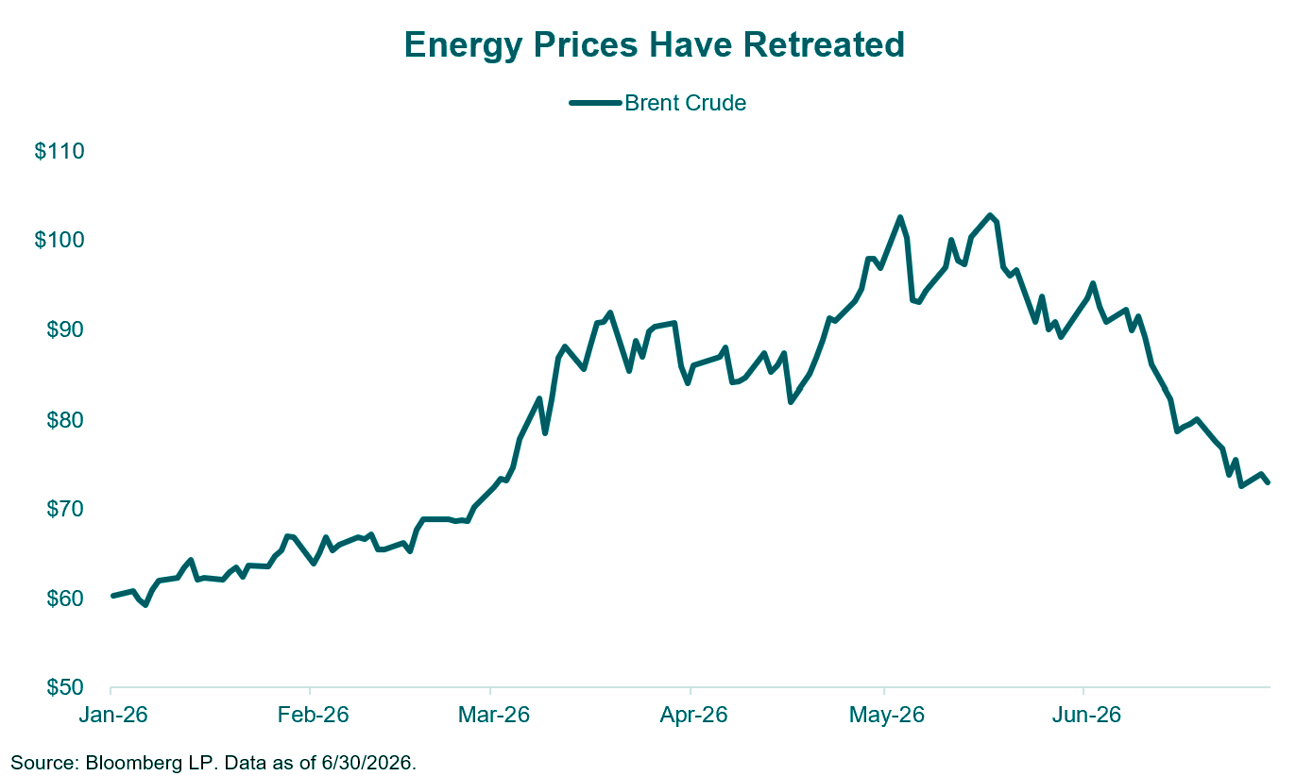
The macro picture inverted during the quarter. Oil collapsed nearly 40% from its conflict peak as a U.S.–Iran ceasefire framework took hold and the Strait of Hormuz began to reopen, pulling Brent crude from around $100/barrel back towards $70 at the end of June. A loosely held ceasefire took effect in early April, and through the middle of the quarter a Pakistan-mediated framework gradually took shape, culminating in a memorandum of understanding signed by President Trump and Iranian President Masoud Pezeshkian in mid-June. Markets responded swiftly—the S&P 500 returned 10.5% in April, its best month since 2020, then added another 5.3% in May, with the index logging nine consecutive weekly gains at one stretch.
June was more contested. Two separate technology-led selloffs rattled the market. On June 5, a disappointing capital-spending signal from Broadcom triggered a semiconductor selloff that erased more than a trillion dollars of market value in a single session. A second round of selling hit around Micron’s earnings in the final full week of the quarter. Neither episode reflected a deterioration in the underlying demand for computing power, but they reminded investors how much risk is concentrated in a handful of names. The Magnificent Seven now represents nearly one-third of the entire S&P 500, a historic level of concentration.
Despite the volatility, the broad market held up well because participation was broadening—the equal-weighted S&P 500, small caps, and previously unloved sectors began to carry their fair share in the final weeks of June. The Russell 2000 is up 22.6% in the first half of the year. Value stocks (Russell 1000 Value Index) outgained their growth counterparts by nearly 500 basis points in June, bringing their year-to-date return to 16.3%. A market that broadens as it climbs is a healthier market than one that narrows.

Returns were also solid outside the United States. Emerging-market equities were the standout, with the MSCI EM Index gaining roughly 24% for the quarter, led by the global scramble for high-bandwidth memory chips that AI systems consume in enormous quantities. MSCI Korea was up 118.6% in the first half of 2026. Japan told a similar story, with equity markets reaching record highs on the same semiconductor tailwinds, while developed European markets posted solid gains as well.
Fixed income offered its own version of the quarter’s round trip. The Federal Reserve made no change to the policy rate—the June meeting marked a fourth consecutive hold at 3.50% to 3.75%. The two-year Treasury yield finished near 4.14%, while the ten-year settled around 4.44%. The thirty-year told the more dramatic story, spiking to 5.18% in mid-May (its highest in nearly two decades) before easing back toward 4.91% at the end of June. The broad Bloomberg U.S. Aggregate Bond Index returned a modest 0.67% for the quarter.
INVESTMENT OUTLOOK & PORTFOLIO POSITIONING
Inflation finally caught up with the energy shock. Headline PCE accelerated to 4.1% year-over-year in May, the highest reading since April 2023, with the May producer price index rising 6.5% year-over-year, the steepest since late 2022. The Fed’s preferred core PCE gauge reached 3.4%, the highest since October 2023. The acceleration has overwhelmingly been an energy story—energy accounted for more than 60% of the monthly increase in consumer prices, and the energy component of CPI was up more than 23% from a year earlier. Strip out energy and the picture is far calmer. This is consistent with our first quarter view that the 2026 inflation episode is fundamentally a supply-driven energy shock rather than a repeat of the broad, demand-driven inflation of 2022. With oil having round-tripped back to pre-war levels by late June, the near-term peak in inflation is likely behind us.
The conflict in the Middle East is far from a settled matter. The truce is fragile and actively contested. In the final days of the quarter, Iran struck a commercial vessel in the strait with a drone, and the U.S. launched retaliatory strikes. The oil market has priced a return to normalcy, but the physical oil market is far from it today. That gap is a risk worth watching closely because much of the disinflation story of the second half rests on it.
New Fed Chair Kevin Warsh was confirmed by the full Senate on May 13th by a vote of 54 to 45, the narrowest margin for a Federal Reserve chair in the modern era. Warsh’s first meeting as chair was held June 16–17. The Committee held the federal funds rate steady at 3.50% to 3.75% by a unanimous vote, but the tone shifted markedly. The post-meeting statement was cut to roughly 130 words and removed much of the forward guidance and easing bias that had characterized the FOMC’s communications for the better part of two years. The accompanying Summary of Economic Projections delivered an upward revision to both inflation and rate expectations. The median projection for the federal funds rate at the end of 2026 moved up to 3.8% from 3.4% in March—an implied rate hike rather than cuts. Nine of eighteen participants projected at least one rate increase this year, and seventeen of eighteen saw inflation risks tilted to the upside. Warsh announced five task forces to examine the inflation framework, productivity measurement in an age of AI, the Fed’s data sources, its communication strategy, and balance sheet management.
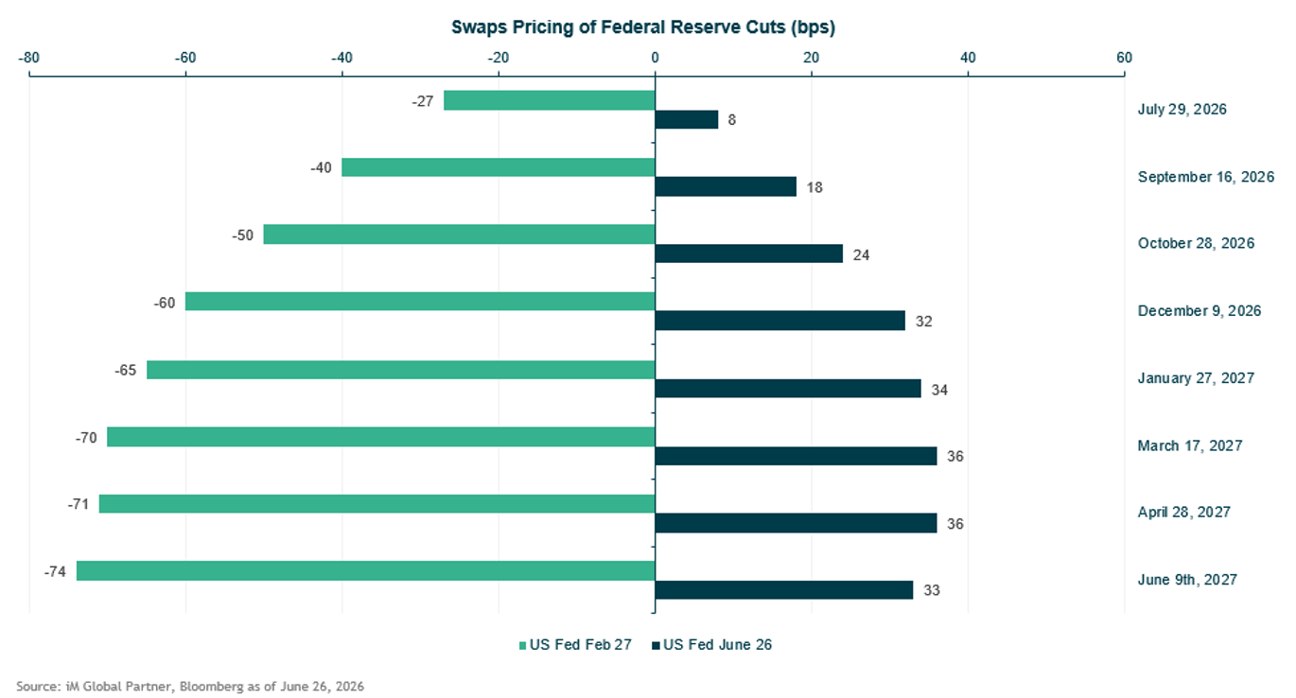
By the end of the quarter, markets had moved to price a meaningful probability of a rate hike by October and a strong likelihood of one by December—a complete reversal of the easing narrative that was present at the start of the year.
In fixed income, credit markets remained calm through the quarter despite two equity drawdowns and a hawkish Fed. High-yield spreads ended at 275 basis points and corporate bond spreads near 75 basis points, both close to multi-year tights. When spreads are this tight, investors are being paid very little to take on credit risk. However, all-in yields for corporate bonds above 5% offer attractive current income. We continue to favor moving up in quality within credit, shortening duration relative to the U.S. Aggregate Bond Index, and investing in active bond funds that can underwrite strong credits.
CLOSING THOUGHTS

We find ourselves at the midpoint of 2026 looking at a market and economy that has remained resilient despite numerous things to worry about. Markets sit near record highs, having recovered everything they lost (and more) in the first quarter, while inflation reached a three-year high, the Federal Reserve pivoted from contemplating cuts to projecting hikes, and a war shut off the key transportation route for many energy commodities.
Our base case is constructive but disciplined. If the truce holds and energy markets remain contained, inflation should continue to recede from its recent peak, the consumer should regain some confidence, and extraordinary earnings growth can continue. In that environment, the most attractive opportunities are not in the names that have already run the furthest but in the broadening we observed later in the second quarter. Our portfolios maintain exposure further down in market capitalization and are more value-oriented when compared to market-cap-weighted indexes. This is not a call against technology stocks or artificial intelligence, both of which we expect to remain central to the market for years. It is a recognition that the risk and reward in the most crowded parts of the market is unbalanced, and that diversification, which felt like a drag during the past few years, will be rewarded. In fixed income, the hawkish turn at the Fed and the pressure at the long end argue for keeping duration underweight, while using the higher absolute yields now available to be selective where the compensation is adequate.
We would frame the path ahead around a few key markers. The first is inflation. If core PCE fails to drop back below roughly 3% as the energy effect fades, or if the Fed delivers the rate hike its projections now imply, we would expect our shorter-duration positions to benefit and longer-duration growth equities to be hurt relative to other areas of the equity market. The second is the war in the Middle East. Much of the disinflation thesis rests on the Strait of Hormuz staying open and oil staying low—a breakdown of the ceasefire and a move in Brent back above $100 would reintroduce stagflation risk. The third is the AI complex. We are watching hyperscaler CAPEX revisions and the guidance from the leading chip and memory companies as the clearest tell on whether the investment cycle is still accelerating or beginning to mature.
The second quarter sent markets to record highs despite numerous unresolved risks. It is a good reminder that markets tend to confound investors—what seems like the “likely” scenario is often different than what actually plays out. This calls for staying invested—earnings growth and the economy still support that—but also for staying diversified, because the concentration at the top of the market is a vulnerability and the broadening beneath it is an opportunity. We thank you for your continued trust and partnership.
Thank you for your continued trust,
- The Owen Legacy Group
This document is provided by iM Global Partner Fund Management, LLC (“iMGPFM”) for informational purposes only and no statement is to be construed as a solicitation or offer to buy or sell a security, or the rendering of personalized investment advice. There is no agreement or understanding that iMGPFM will provide individual advice to any investor or advisory client in receipt of this document. Certain information constitutes “forward-looking statements” and due to various risks and uncertainties actual events or results may differ from those projected. Some information contained in this report may be derived from sources that we believe to be reliable; however, we do not guarantee the accuracy or timeliness of such information. Past performance may not be indicative of future results and there can be no assurance the views and opinions expressed herein will come to pass. Investing involves risk, including the potential loss of principal. Any reference to a market index is included for illustrative purposes only, as an index is not a security in which an investment can be made. Indexes are unmanaged vehicles that do not account for the deduction of fees and expenses generally associated with investable products. For additional information about iMGPFM, please consult the Firm’s Form ADV disclosure documents, the most recent versions of which are available on the SEC’s Investment Adviser Public Disclosure website (adviserinfo.sec.gov) and may otherwise be made available upon written request.
Risk assets staged a powerful reversal in the second quarter. After a negative first quarter highlighted by conflict in the Middle East, the S&P 500 rallied 15.2% over the three months, setting a record close on June 1st before a late-June pullback in technology trimmed the gains. The index is now up 10.2% for the year. The quarter’s defining feature was a melt-up in equities occurring against a backdrop of accelerating inflation, a newly hawkish Federal Reserve, and an unresolved war with Iran.
The macro picture inverted during the quarter. Oil collapsed nearly 40% from its conflict peak as a U.S.–Iran ceasefire framework took hold and the Strait of Hormuz began to reopen, pulling Brent crude from around $100/barrel back towards $70 at the end of June. A loosely held ceasefire took effect in early April, and through the middle of the quarter a Pakistan-mediated framework gradually took shape, culminating in a memorandum of understanding signed by President Trump and Iranian President Masoud Pezeshkian in mid-June. Markets responded swiftly—the S&P 500 returned 10.5% in April, its best month since 2020, then added another 5.3% in May, with the index logging nine consecutive weekly gains at one stretch.
June was more contested. Two separate technology-led selloffs rattled the market. On June 5, a disappointing capital-spending signal from Broadcom triggered a semiconductor selloff that erased more than a trillion dollars of market value in a single session. A second round of selling hit around Micron’s earnings in the final full week of the quarter. Neither episode reflected a deterioration in the underlying demand for computing power, but they reminded investors how much risk is concentrated in a handful of names. The Magnificent Seven now represents nearly one-third of the entire S&P 500, a historic level of concentration.
Despite the volatility, the broad market held up well because participation was broadening—the equal-weighted S&P 500, small caps, and previously unloved sectors began to carry their fair share in the final weeks of June. The Russell 2000 is up 22.6% in the first half of the year. Value stocks (Russell 1000 Value Index) outgained their growth counterparts by nearly 500 basis points in June, bringing their year-to-date return to 16.3%. A market that broadens as it climbs is a healthier market than one that narrows.
Returns were also solid outside the United States. Emerging-market equities were the standout, with the MSCI EM Index gaining roughly 24% for the quarter, led by the global scramble for high-bandwidth memory chips that AI systems consume in enormous quantities. MSCI Korea was up 118.6% in the first half of 2026. Japan told a similar story, with equity markets reaching record highs on the same semiconductor tailwinds, while developed European markets posted solid gains as well.
Fixed income offered its own version of the quarter’s round trip. The Federal Reserve made no change to the policy rate—the June meeting marked a fourth consecutive hold at 3.50% to 3.75%. The two-year Treasury yield finished near 4.14%, while the ten-year settled around 4.44%. The thirty-year told the more dramatic story, spiking to 5.18% in mid-May (its highest in nearly two decades) before easing back toward 4.91% at the end of June. The broad Bloomberg U.S. Aggregate Bond Index returned a modest 0.67% for the quarter.
INVESTMENT OUTLOOK & PORTFOLIO POSITIONING
Inflation finally caught up with the energy shock. Headline PCE accelerated to 4.1% year-over-year in May, the highest reading since April 2023, with the May producer price index rising 6.5% year-over-year, the steepest since late 2022. The Fed’s preferred core PCE gauge reached 3.4%, the highest since October 2023. The acceleration has overwhelmingly been an energy story—energy accounted for more than 60% of the monthly increase in consumer prices, and the energy component of CPI was up more than 23% from a year earlier. Strip out energy and the picture is far calmer. This is consistent with our first quarter view that the 2026 inflation episode is fundamentally a supply-driven energy shock rather than a repeat of the broad, demand-driven inflation of 2022. With oil having round-tripped back to pre-war levels by late June, the near-term peak in inflation is likely behind us.
The conflict in the Middle East is far from a settled matter. The truce is fragile and actively contested. In the final days of the quarter, Iran struck a commercial vessel in the strait with a drone, and the U.S. launched retaliatory strikes. The oil market has priced a return to normalcy, but the physical oil market is far from it today. That gap is a risk worth watching closely because much of the disinflation story of the second half rests on it.
New Fed Chair Kevin Warsh was confirmed by the full Senate on May 13th by a vote of 54 to 45, the narrowest margin for a Federal Reserve chair in the modern era. Warsh’s first meeting as chair was held June 16–17. The Committee held the federal funds rate steady at 3.50% to 3.75% by a unanimous vote, but the tone shifted markedly. The post-meeting statement was cut to roughly 130 words and removed much of the forward guidance and easing bias that had characterized the FOMC’s communications for the better part of two years. The accompanying Summary of Economic Projections delivered an upward revision to both inflation and rate expectations. The median projection for the federal funds rate at the end of 2026 moved up to 3.8% from 3.4% in March—an implied rate hike rather than cuts. Nine of eighteen participants projected at least one rate increase this year, and seventeen of eighteen saw inflation risks tilted to the upside. Warsh announced five task forces to examine the inflation framework, productivity measurement in an age of AI, the Fed’s data sources, its communication strategy, and balance sheet management.
By the end of the quarter, markets had moved to price a meaningful probability of a rate hike by October and a strong likelihood of one by December—a complete reversal of the easing narrative that was present at the start of the year.
In fixed income, credit markets remained calm through the quarter despite two equity drawdowns and a hawkish Fed. High-yield spreads ended at 275 basis points and corporate bond spreads near 75 basis points, both close to multi-year tights. When spreads are this tight, investors are being paid very little to take on credit risk. However, all-in yields for corporate bonds above 5% offer attractive current income. We continue to favor moving up in quality within credit, shortening duration relative to the U.S. Aggregate Bond Index, and investing in active bond funds that can underwrite strong credits.
CLOSING THOUGHTS
We find ourselves at the midpoint of 2026 looking at a market and economy that has remained resilient despite numerous things to worry about. Markets sit near record highs, having recovered everything they lost (and more) in the first quarter, while inflation reached a three-year high, the Federal Reserve pivoted from contemplating cuts to projecting hikes, and a war shut off the key transportation route for many energy commodities.
Our base case is constructive but disciplined. If the truce holds and energy markets remain contained, inflation should continue to recede from its recent peak, the consumer should regain some confidence, and extraordinary earnings growth can continue. In that environment, the most attractive opportunities are not in the names that have already run the furthest but in the broadening we observed later in the second quarter. Our portfolios maintain exposure further down in market capitalization and are more value-oriented when compared to market-cap-weighted indexes. This is not a call against technology stocks or artificial intelligence, both of which we expect to remain central to the market for years. It is a recognition that the risk and reward in the most crowded parts of the market is unbalanced, and that diversification, which felt like a drag during the past few years, will be rewarded. In fixed income, the hawkish turn at the Fed and the pressure at the long end argue for keeping duration underweight, while using the higher absolute yields now available to be selective where the compensation is adequate.
We would frame the path ahead around a few key markers. The first is inflation. If core PCE fails to drop back below roughly 3% as the energy effect fades, or if the Fed delivers the rate hike its projections now imply, we would expect our shorter-duration positions to benefit and longer-duration growth equities to be hurt relative to other areas of the equity market. The second is the war in the Middle East. Much of the disinflation thesis rests on the Strait of Hormuz staying open and oil staying low—a breakdown of the ceasefire and a move in Brent back above $100 would reintroduce stagflation risk. The third is the AI complex. We are watching hyperscaler CAPEX revisions and the guidance from the leading chip and memory companies as the clearest tell on whether the investment cycle is still accelerating or beginning to mature.
The second quarter sent markets to record highs despite numerous unresolved risks. It is a good reminder that markets tend to confound investors—what seems like the “likely” scenario is often different than what actually plays out. This calls for staying invested—earnings growth and the economy still support that—but also for staying diversified, because the concentration at the top of the market is a vulnerability and the broadening beneath it is an opportunity. We thank you for your continued trust and partnership.
Thank you for your continued trust,
- The Owen Legacy Group
This document is provided by iM Global Partner Fund Management, LLC (“iMGPFM”) for informational purposes only and no statement is to be construed as a solicitation or offer to buy or sell a security, or the rendering of personalized investment advice. There is no agreement or understanding that iMGPFM will provide individual advice to any investor or advisory client in receipt of this document. Certain information constitutes “forward-looking statements” and due to various risks and uncertainties actual events or results may differ from those projected. Some information contained in this report may be derived from sources that we believe to be reliable; however, we do not guarantee the accuracy or timeliness of such information. Past performance may not be indicative of future results and there can be no assurance the views and opinions expressed herein will come to pass. Investing involves risk, including the potential loss of principal. Any reference to a market index is included for illustrative purposes only, as an index is not a security in which an investment can be made. Indexes are unmanaged vehicles that do not account for the deduction of fees and expenses generally associated with investable products. For additional information about iMGPFM, please consult the Firm’s Form ADV disclosure documents, the most recent versions of which are available on the SEC’s Investment Adviser Public Disclosure website (adviserinfo.sec.gov) and may otherwise be made available upon written request.